
ADVANCED INJECTION TECHNOLOGY FOR ACID GAS MITIGATION & ALTERNATIVE FUEL INTEGRATION

Executive Summary
Environmental regulations continue to impose strict limits on Hazardous Air Pollutants (HAPs), forcing industrial processors and power utilities to deploy highly efficient, ultra-reliable mitigation systems for their boilers and furnaces. For decades, Dry Sorbent Injection (DSI) and Activated Carbon Injection (ACI) have stood as the industry standard methods for capturing acid gasses—such as sulfur dioxide (SO2), sulfur trioxide(SO3), and hydrochloric (HCl) acid —and mercury gas respectively from the flue gas stream.
As the global push for sustainability accelerates, industries such as cement manufacturing and mineral processing are rapidly transitioning to alternative fuels (e.g., biomass, municipal solid waste, and construction debris) to offset their carbon footprint. However, use of these non-standard fuels introduces unpredictable chemical compounds which when incinerated, drastically increases acid gas surges in the flue gas stream.
Delta Ducon delivers durable, reliable, and specially engineered pneumatic conveying and injection systems; Backed by a proven track record of supplying hundreds of advanced injection systems throughout North America. This paper outlines the technical and economic advantages of Delta Ducon’s proprietary equipment, demonstrating how precision engineering and wear-resistant design provide an uncompromised solution for both heavy industry and utility applications.
Technical Overview of DSI
Dry Sorbent Injection relies on the pneumatic injection of alkaline reagents directly into hot flue gas ducts. The reagents react with acid gas constituents, capturing them into solid particulate byproducts that are collected downstream via an Electrostatic Precipitator (ESP) or a Pulse Jet Fabric Filter (PJFF).
Key Reagents & Applications
Hydrated Lime: Hydrated lime is low cost and highly effective for the capture of SO3 and HCl. It reacts via standard acid-base neutralization, making it a staple for coal-fired power plants and industrial biomass boilers.
Trona & Sodium Bicarbonate: Sodium-based sorbents are utilized when significant SO2 reduction is required beyond just SO3 and HCl. These reagents undergo calcination inside the flue gas duct, creating a highly porous structure that maximizes contact area for neutralization.
Powdered Activated Carbon (PAC): PAC is the industry standard for capturing mercury in flue gas. PAC has enormous internal surface area from all its micropores ensuring high adsorption efficiency. For added mercury removal efficiency, halogenated PAC, such as brominated PAC (BPAC), may be used.
Market Driver: Alternative Fuels in Cement and Mineral Processing
Environmental regulations and the economics and of modern heavy industry dictate a shift toward alternative fuels. In cement kilns and mineral processing plants, traditional coal and coke are increasingly supplemented or replaced by alternative fuel sources. While economically sound, this substitution poses serious operational challenges.
The Fuel Composition Dilemma: Use of alternative fuels introduces unpredictable chemical compounds. Plastics and waste content spike HCl levels, waste wood generates variable SO2 profiles, and municipal waste components trigger volatile mercury excursions.
Without highly responsive and reliable injection technology, these chemical surges trigger emissions violations and associated financial penalties. Acid gasses can also cause increased corrosion in downstream ductwork and particulate collection systems. Advanced injection systems must be capable of metering precise amounts of reagent continuously with minimal down time, to mitigate the pollutants effectively and efficiently.
Delta Ducon System Design & Equipment Advantages
Where generic system integrators rely on low-end commercial components, Delta Ducon engineers heavy-duty material handling equipment capable of withstanding the highly abrasive, cohesive, and corrosive nature of industrial sorbents.
1. Material Handling Expertise
Delta Ducon is specialized in the handling of high abrasive compounds for pneumatic conveying. Our experience in designing system includes fine details and nuances which ultimately determine if a system is well running and reliably long lasting, or if the convey system is under capacity and components wear prematurely.
2. Premium Equipment vs. Commodity Hardware
Delta Ducon designs systems with components engineered and manufactured in house specifically for highly abrasive materials.
PERMA/flo® XT eXtreme Rotary Valves
Our PERMA/flo® XT rotary valves are designed to accurately meter dry sorbent reagents into pneumatic conveying systems while delivering exceptional durability in abrasive service applications. The XT Rotary Valve incorporates several unique design features that significantly enhance reliability, service life, and maintainability:
• Unlike conventional rotary valves, where the rotor seals directly against the housing, the XT Rotary Valve design seals the rotor against a replaceable inlet shoe. Both the rotor and inlet shoe are replaceable components, eliminating the need to replace the entire valve assembly when sealing tolerances can no longer be maintained
• Rotor-to-shoe clearance is field adjustable, allowing operators to maintain a tight seal without removing the valve from service. Multiple adjustments can be made before parts replacement is required.
• The rotor and inlet shoe are cast of a Ni-Hard alloy with a hardness of 500-600 BHN. This is not a surface hardening that wears off and exposes softer base materials.
• Sealed-end rotor construction minimizes air blow-by and improves conveying efficiency.
• Bearings are outboard and self-aligning thus capable of tolerating high temperatures.
• Feeders incorporate air purge connections to provide sealing air, preventing dusting at the shaft seals.
The adjustable rotor assembly is one of the most critical advantages of the XT rotary airlock design. Maintaining close tolerances between the rotor and inlet shoe is essential to minimize blow-by and maximize feed efficiency and accuracy. Abrasive powders will erode this critical area of the feeder through wiredraw wear. Therefore, it is essential to incorporate materials of construction which are proven to resist wear while also maintaining sealing clearances. The XT valve is constructed of Ni-Hard Alloy, which has an excellent track record with fine, abrasive material. Combined with simple in-field adjustment and replaceable wear components, the PERMA/flo® XT rotary valve provides a robust, serviceable, and cost-effective rotary valve solution for severe-duty applications.

PERMA/flo® Integral Wear Back (IWB) Abrasion Resistant Elbows
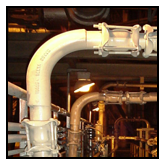
While some competitors utilize standard long-radius carbon steel elbows, Delta Ducon employs proprietary PERMA/flo® IWB Elbows. PERMA/flo® IWB elbows are cast from the same Ni-Hard alloys used in our XT Rotary Valves, providing exceptional resistance to abrasive wear. In addition to incorporating a bend radius equal to three times the pipe diameter to minimize pressure drop and wear, these elbows feature strategically reinforced wear sections with increased material thickness to maximize service life.
Feed Accuracy
While effective pollutant removal from the flue gas stream is the primary objective, minimizing operating costs is also a critical consideration. Maintaining accurate reagent injection rates is therefore essential to ensure both environmental compliance and efficient reagent utilization.
To achieve precise feed control, the metering system utilizes a gravimetric “loss-in-weight” weighing system. The system consists of a weigh hopper mounted on load cells, along with a dedicated weigh controller that continuously monitors hopper weight and provides the signal required for automated loss-in-weight control operation. The weigh hopper is vented back to the silo roof to maintain positive airflow during refill cycles and ensure stable feeding performance. For lower injection rate applications such as ACI, a gravimetric screw feeder is employed.
Using the loss-in-weight control method, gravimetric feeders typically achieve feed accuracies in the range of ±1–5%, providing reliable and consistent reagent delivery.

3. Advanced Motive Air Configuration
A common industry debate centers around the choice of motive air sources for pneumatic conveying. Delta Ducon provides comprehensive design validation comparing low-pressure Positive Displacement (PD) Blowers against traditional plant Air Compressors.
The PD Blower Edge: Operating at optimized lower pressures inherently reduces convey air temperatures, keeping the system below the critical threshold where sorbents begin to bake, scale, or chemically degrade inside the pipeline. Use of low pressure system is inherently safer and avoids the need for expensive coded pressure vessels and air compressors.
Thermal & Moisture Control Packaging: Systems can be outfitted with dedicated desiccant air dryers and air-to-air heat exchangers to consistently maintain transport air temperatures and reduce moisture to reduce and even eliminate compaction and material build up in the convey line.

Conclusion
The intersection of strict environmental mandates and alternative fuel economics demands highly specialized dry sorbent injection systems. Generic, unengineered component packages while low con CAPEX, will inevitably lead to line pluggages, under capacity issues, uneven reagent distribution, premature wear, piping blowouts, and non-compliance fines.
Delta Ducon’s industrial legacy is built on solving these specific material handling problems. Through abrasion resistant components and precision metering technologies, Delta Ducon delivers systems engineered to keep heavy industrial operations and utility generation compliant, reliable, and profitable regardless of the fuel composition.

