5 Signs Your Pneumatic Conveying System Is Costing You Money

Most conveying systems don't fail all at once. They get a little worse every year. A line that used to plug once a quarter starts plugging once a month. The blower runs a bit harder. Maintenance replaces the same elbow for the third time. Nobody writes it up as a crisis because the material is still moving.
But "still moving" and "running well" aren't the same thing, and the gap between them costs real money.
If your pneumatic conveying system is plugging often, falling short of its rated capacity, using more air than it should, chewing through wear parts, or causing unplanned downtime, it's costing your plant more than you probably realize. In cement, mining and minerals, where you're moving abrasive materials like cement, fly ash, kiln dust and raw meal, these problems tend to feed off each other.
This isn't just us saying it
In a June 2026 IMechE webinar, researchers from the Wolfson Centre for Bulk Solids Handling Technology at the University of Greenwich made the same point. Many installed systems block, wear rapidly, use far more energy than necessary, or never reach their designed throughput, and the economic cost of that gap is often underestimated.
That matches what we see in plants. The cost rarely shows up as one big number. It's scattered across the maintenance budget, the power bill, overtime, and production that never happened. So here's what to look for.

1. You're clearing plugs more than you should be
Every plant has a line that everyone knows about. The one that plugs if you look at it wrong.
Line plugging almost always comes down to air velocity dropping below what the material needs to stay moving. Sometimes that's a design problem. More often, something has changed. The rotary valve has worn and is leaking air, the feed rate is surging, or the material itself isn't what the system was designed for.
That last one matters more than it used to. A lot of plants have moved to blended cements and are bringing in slag, harvested fly ash or calcined clay. Those materials don't always behave like what your system was built to handle 20 years ago.
Each plug costs you conveying time, operator time, and sometimes a backed-up mill or silo upstream.
2. The line doesn't hit its rated capacity anymore
If a line was rated for a certain tons per hour and now it only gets there on a good day, something is eating the capacity.
Usually it's air going where it shouldn't, through a worn airlock or out of a leaking fitting. Sometimes it's added resistance from worn or badly designed bends. Sometimes the air supply was never really matched to how much the plant produces today.
Here's why this one hurts. If conveying is the bottleneck, everything else slows down to match it. You can have a mill or kiln ready to produce more and still be held back by the pipe that feeds it.
3. Your blowers are working harder than they used to
Compressed air is expensive, and a worn rotary valve is one of the quietest ways to waste it.
The rotary valve does two jobs: it feeds material into the line and it acts as an airlock. As the rotor and housing wear, the clearance between them opens up. Conveying air starts leaking back through the valve instead of pushing material down the pipe. Your blower makes up the difference, and you pay for air that moves nothing.
It also makes the feed rate less stable, which takes you right back to sign #1.
If you want the engineering detail, our team wrote a technical deep dive on PERMA/flo Extreme Rotary Valves that explains why holding a tight rotor-to-shoe gap, even as the valve wears, makes such a difference to airlock efficiency.
4. You keep replacing the same elbows
Cement, clinker dust, fly ash and silica are hard on equipment. That's not news to anyone who's worked in a cement plant.
What surprises people is how much the design affects wear. A 2026 engineering review of pneumatic conveying found that how fast components wear depends on the speed of the conveying gas and how concentrated the material is in the flow. Bends take the worst of it, because that's where material changes direction and slams into the pipe wall.
So if you're seeing elbow blowouts, dust around fittings, or a spare parts budget that keeps climbing, the answer usually isn't to keep buying the same parts. It's to use abrasion-resistant pipe and elbows, diverters designed to move wear away from the valve body, and rotary valves built from wear-resistant alloys instead of standard or surface-hardened steel.
5. Unplanned downtime has become "normal"
This is where the first four signs catch up with you.
A worn valve leaks air. That causes plugs. Operators push more pressure to clear them. Higher velocity speeds up wear in the pipeline. Eventually an elbow or a valve lets go, and it never happens at a convenient time.
If conveying problems show up in shift reports every week, or your maintenance crew has a line they "keep an eye on," you're already paying for this. Unplanned downtime is usually the biggest cost of a struggling conveying system, because it stops production, not just the line.
So what's it actually costing you?
You don't need a consultant to get a rough number. Most plants already track what you need:
Lost production: hours of conveying-related downtime × production rate × margin per ton
Labor: hours spent clearing plugs and swapping wear parts × your loaded labor rate
Parts: what you spent last year on elbows, pipe, valve rotors and seals
Energy: extra blower or compressor run time from leakage or poor design
Cleanup: time spent on dust and spills from leaking fittings
Add it up and compare it to the cost of fixing your worst line. In most plants, one or two problem lines account for most of the pain, so a targeted upgrade often pays for itself much faster than people expect.
Repair or upgrade?
If something failed once, fix it. If the same line keeps failing, or your material has changed since the system was designed, or parts for older equipment are getting expensive and slow to get, it's time to think about an upgrade.
That doesn't have to mean a new system. Often the best payback comes from replacing the parts that fail most: the rotary valve, the elbows and the diverters.
At a cement plant in Xenia, Ohio, for example, we installed an 8" Extreme Duty Rotary Feeder in place of a competitor's double flap gate valve to handle 3.5 TPH of high-temperature cement kiln dust. There are more examples like that in our article on the Triple Threat to Downtime.
A bit about us
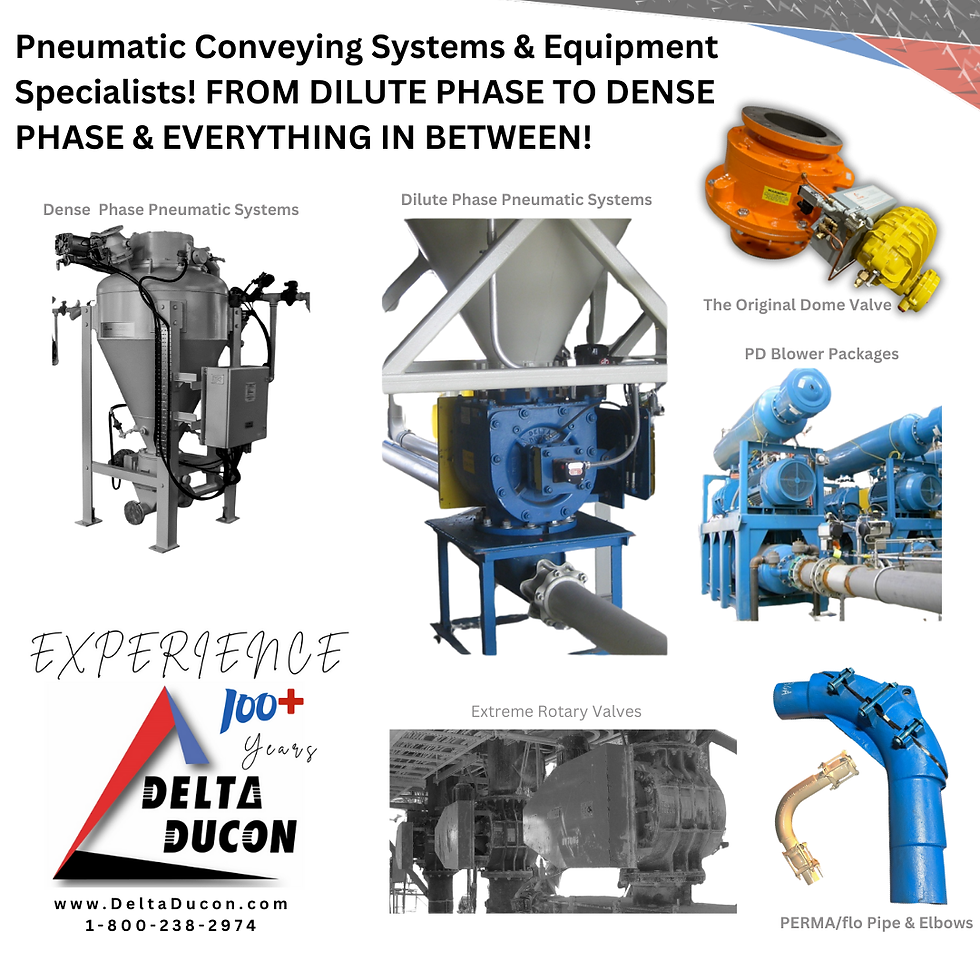
Delta Ducon has been building pneumatic conveying systems and severe-duty components for heavy industry for more than 100 years, and we still build our core equipment in Pennsylvania. Our cement, mining and minerals solutions cover dilute, dense and semi-dense phase conveying, Extreme Duty Rotary Valves, PERMA/flo abrasion-resistant pipe and elbows, and KG Diverter Valves.
This year, we were honored to take first place in the American Cement Association's 2026 Manufacturers' Performance Awards for our PERMA/flo Extreme Duty Rotary Valve.
Frequently asked questions
What's the most common cause of conveying problems in cement plants? In our experience, it's often the rotary valve. As it wears, air leaks back through it. That makes the feed less stable, pushes energy costs up, and makes plugs more likely.
How can I tell if my rotary valve is leaking too much air? Watch for unstable line pressure, lower throughput, more frequent plugs, and blowers working harder than they used to. If you can see wear on the rotor tips or housing during an inspection, that's a pretty clear sign.
Why do elbows wear out so much faster than straight pipe?Because that's where the material changes direction and hits the pipe wall. Elbows take most of the abuse in any abrasive conveying line.
Do I have to replace my whole system to fix these problems? Usually not. A lot of plants get the best return by upgrading just the components that keep failing, like rotary valves, elbows and diverters, and keeping the rest.
We've switched to blended cement. Could that affect our conveying system? It can. Slag, harvested fly ash and calcined clay can flow, pack and wear differently from what your system was designed for. If your plugging or wear problems started around the time your mix changed, that's worth looking into.
Let's take a look at your problem line
Every plant has one. If yours is plugging, eating wear parts, or holding back production, give us a call. Our engineers will help you figure out what's really going on and what it'll take to fix it.
Call (800) 238-2974 or email info@deltaducon.com to set up a conveying system review.